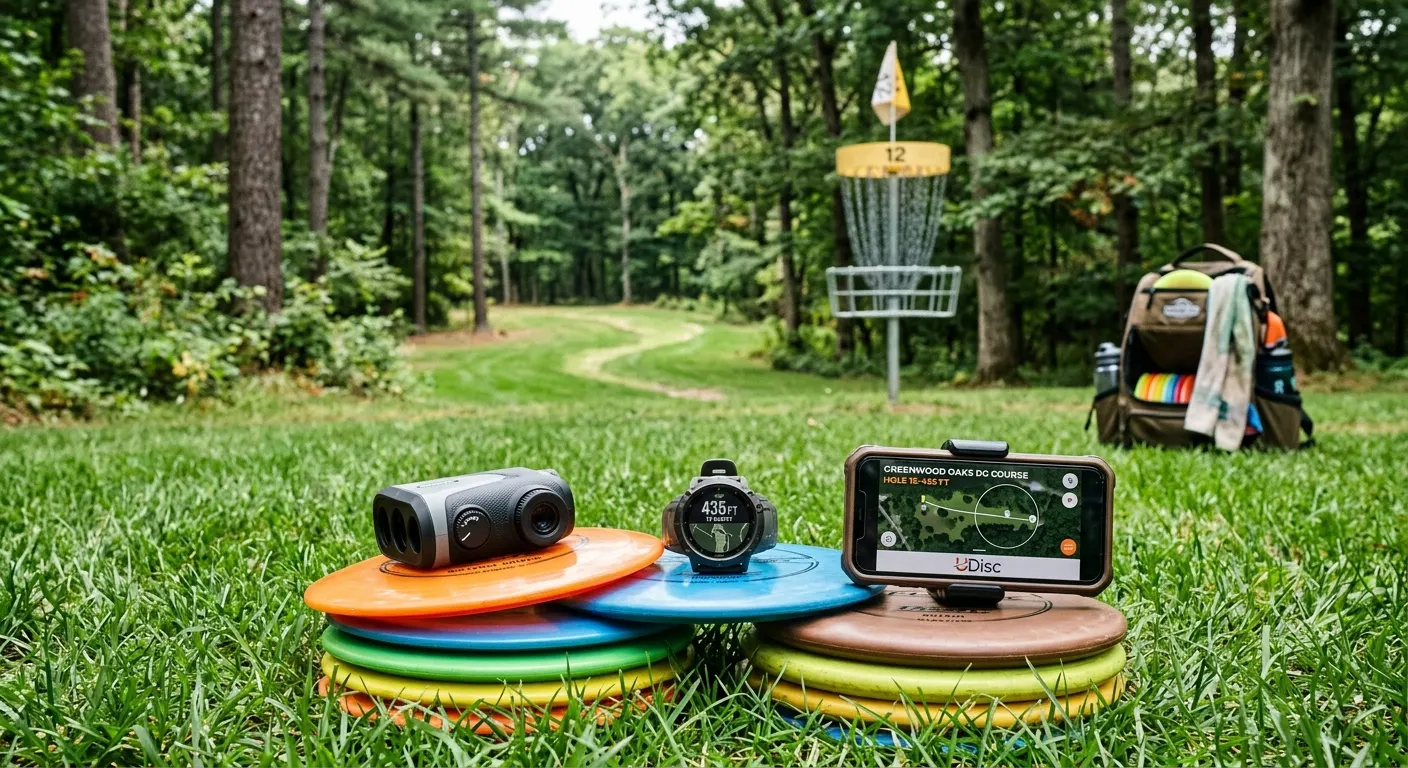
Misjudging distance on a long uphill hole is one of the most common reasons a disc lands short or sails over. A Bushnell Phantom 2 Disc Golf Rangefinder gives you an exact distance in under a second, removing the guesswork that costs strokes on unfamiliar courses. But a laser rangefinder is not the right tool for every player or budget. This guide compares laser rangefinders, GPS-based solutions like UDisc, and the Voice Caddie SL1 Laser Rangefinder with audio readout to help you decide what is actually worth buying for your game.
Quick answer
A laser rangefinder like the Bushnell Phantom 2 is the most accurate shot-distance tool in disc golf, measuring to within 1 yard on any visible target. UDisc GPS is accurate to within 10-15 feet on mapped courses and is free on your phone. Most serious players use both: UDisc for hole strategy and a laser for shot distance confirmation.
This guide contains affiliate links. DiscDialed may earn a commission at no cost to you.
Laser rangefinders: the most accurate distance tool
A laser rangefinder emits a pulse of infrared light that bounces off the target and returns, giving a distance measurement accurate to within 1 yard in roughly half a second. For disc golf, this means aiming at the basket pole or a specific tree in your line and getting an exact number to plan your shot.
The Bushnell Phantom 2 Disc Golf Rangefinder is the most recommended model in disc golf communities in 2026 because of its built-in magnetic mount, slope toggle, and 450-yard range. The magnetic mount sticks to most metal bag buckles and cart frames so the unit is always within reach. The slope toggle is a critical feature: slope-compensated mode gives you the uphill-adjusted distance for accurate club or disc selection, but PDGA rules require you to turn it off during sanctioned competition.
The Precision Pro NX7 Rangefinder is the best option for players who want laser accuracy under $100 without the magnetic mount or slope feature. It reads to 400 yards and acquires targets quickly in wooded corridors, making it practical for the tight fairway conditions disc golf courses often present.

Bushnell Phantom 2 Disc Golf Rangefinder
Laser rangefinder accurate to 450 yards with a built-in magnetic cart-or-bag mount, a slope-toggle for legal tournament mode, and a fast single-button operation. The Phantom 2 is the most-recommended entry-level rangefinder in disc golf communities.
Precision Pro NX7 Rangefinder
Budget-friendly laser rangefinder with 400-yard range, fast target acquisition, and a lightweight monocular body. The NX7 is the best fully featured laser rangefinder under $100 that still delivers course-useful accuracy.
Voice Caddie SL1 Laser Rangefinder
Compact laser rangefinder with vocal distance readout, eliminating the need to read a small LCD while holding the unit steady. The SL1 is a useful option for players who have trouble reading small displays in bright sunlight.
GPS and UDisc: course mapping versus laser accuracy
UDisc is a free app that uses GPS to measure your distance to the basket on thousands of mapped disc golf courses worldwide. GPS accuracy is typically 10 to 15 feet, which is adequate for most shot planning but less precise than a laser on approach shots where 15 feet matters.
The advantage of UDisc over a laser is that it works without line of sight. On a wooded dogleg where you cannot see the basket, UDisc shows you the straight-line distance from your GPS position to the basket regardless of obstacles. A laser rangefinder requires a clear sightline to measure.
Many serious players use both in tandem: UDisc to understand the hole layout and get a rough distance, then the Bushnell Phantom 2 Disc Golf Rangefinder to confirm the exact distance on the shot they have decided to throw. The two tools are complementary rather than competitive.
Bushnell Phantom 2 Disc Golf Rangefinder
Laser rangefinder accurate to 450 yards with a built-in magnetic cart-or-bag mount, a slope-toggle for legal tournament mode, and a fast single-button operation. The Phantom 2 is the most-recommended entry-level rangefinder in disc golf communities.
Precision Pro NX7 Rangefinder
Budget-friendly laser rangefinder with 400-yard range, fast target acquisition, and a lightweight monocular body. The NX7 is the best fully featured laser rangefinder under $100 that still delivers course-useful accuracy.
PDGA tournament legality: what you need to know
PDGA rules prohibit devices that provide slope-compensated distance readings during a sanctioned round. A rangefinder in slope mode is illegal during PDGA competition. The Bushnell Phantom 2 Disc Golf Rangefinder addresses this with a physical slope toggle that switches between compensated (practice mode) and legal non-compensated mode. Before any sanctioned round, verify your rangefinder is switched to non-slope mode.
GPS apps like UDisc are permitted in PDGA competition for distance and mapping functions, as long as the device is not used for any other game analysis function prohibited by the rules. Using UDisc to check distance to the basket during a round is legal. Consult the current PDGA Technical Standards for any rule changes before competition.
The Voice Caddie SL1 Laser Rangefinder does not have slope compensation, which makes it inherently legal in tournament mode. Its audio readout is the distinctive feature: it speaks the distance aloud so you do not need to read a small LCD display while keeping the unit trained on the target.
Bushnell Phantom 2 Disc Golf Rangefinder
Laser rangefinder accurate to 450 yards with a built-in magnetic cart-or-bag mount, a slope-toggle for legal tournament mode, and a fast single-button operation. The Phantom 2 is the most-recommended entry-level rangefinder in disc golf communities.
Voice Caddie SL1 Laser Rangefinder
Compact laser rangefinder with vocal distance readout, eliminating the need to read a small LCD while holding the unit steady. The SL1 is a useful option for players who have trouble reading small displays in bright sunlight.
Precision Pro NX7 Rangefinder
Budget-friendly laser rangefinder with 400-yard range, fast target acquisition, and a lightweight monocular body. The NX7 is the best fully featured laser rangefinder under $100 that still delivers course-useful accuracy.
Featured in this guide
Bushnell Phantom 2 Disc Golf Rangefinder
Laser rangefinder accurate to 450 yards with a built-in magnetic cart-or-bag mount, a slope-toggle for legal tournament mode, and a fast single-button operation. The Phantom 2 is the most-recommended entry-level rangefinder in disc golf communities.
Precision Pro NX7 Rangefinder
Budget-friendly laser rangefinder with 400-yard range, fast target acquisition, and a lightweight monocular body. The NX7 is the best fully featured laser rangefinder under $100 that still delivers course-useful accuracy.
Voice Caddie SL1 Laser Rangefinder
Compact laser rangefinder with vocal distance readout, eliminating the need to read a small LCD while holding the unit steady. The SL1 is a useful option for players who have trouble reading small displays in bright sunlight.
Related roundups
FAQ
Frequently asked questions
Is a rangefinder worth it for casual disc golf?+
If you play the same course every week, you will quickly memorize distances and get less value from a rangefinder. If you play different courses regularly, travel to disc golf destinations, or want to remove uncertainty from approach shots, a laser rangefinder pays for itself in better shot selection within a few rounds. The Bushnell Phantom 2 at around $125 is the entry point that most players cite as worth the investment.
Can I use my golf rangefinder for disc golf?+
Yes, with one caveat. Golf rangefinders are designed to range flags and golfer-sized targets. Disc golf basket poles are thinner than a flag, and some older golf rangefinders struggle to lock on to a basket at distance. A modern rangefinder with a fast pulse repetition rate like the Bushnell Phantom 2 handles basket poles without difficulty. Test yours on an actual basket before relying on it for shot planning.